Planning tools are typically designed for the present. They help manage what is known, optimise what already exists.
By compressing time and running large volumes of traffic scenarios, Air traffic Management (ATM) planners can test responses to situations that haven’t happened yet.
A new terminal opening in a congested corridor. A structural shift in flows between two major hubs. The goal isn’t prediction, it’s preparation. As such, fast time simulation capabilities would be very useful for the fast-growing APAC region, which can be seen from the following projections:
46%of air passengers over the next 20 years will come from Asia-Pacific | 60%of global airport development projects are currently underway in Asia-Pacific, according to industry estimates (CAPA, 2024) | +2,750By 2043, Asia-Pacific alone will account for 2.75 billion additional passengers |
Why no single ANSP can do this alone
Individual Air Navigation Service Providers (ANSPs) can model their own airspace with considerable precision. What’s harder to capture in isolation are the cross-border dynamics: a rerouting decision in one sector that creates pressure in the next, a weather event that redistributes flows across a sub-region, infrastructure changes whose effects extend well beyond national boundaries.
“The most complex dynamics only become visible when the region is considered as a whole. Local models can tell you what’s happening in your sector, but not why flows are shifting three FIRs away.” — Chris Lee, AIR Lab Director |
Asia-Pacific is in the middle of a significant transformation. New international airports are coming online. High-density routes are emerging between hubs. Each of these developments carries regional consequences that are genuinely difficult to anticipate from a national perspective alone.
What the Regional Collaboration Platform makes possible
One specific challenge of regional simulation is data. Operational data is sensitive and sovereign. It cannot flow freely between organisations. Yet building realistic regional scenarios requires inputs that reflect the system in its entirety.
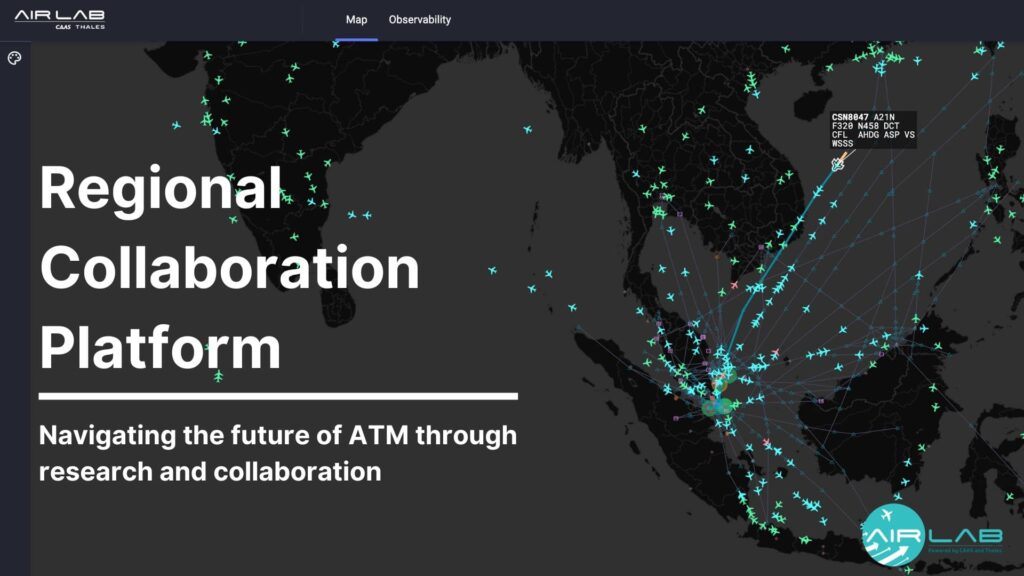
The RCP addresses this by combining historical traffic records, synthetic scenarios, and AI-generated flight plans. ANSPs work on shared research questions within a common environment. The result is a neutral space where teams can test concepts, compare findings, and build a shared understanding of how the regional airspace is likely to evolve.
Simulation workflow on the RCP
- Historical data ingestion
Traffic records, weather events, and flight plan data from across the region are ingested and normalised for simulation use.
- AI-assisted scenario generation
Synthetic flight plans and traffic surges are modelled to replicate conditions that don’t yet exist, but credibly could.
- Cross-FIR simulation
Scenarios run across multiple airspace boundaries: typhoon rerouting cascades, new terminal openings, peak-traffic stress tests.
- Shared analysis and KPIs
Build understanding, and refine regional airspace concepts
“The RCP lets us build scenarios that are regional by design, using real data patterns without exposing real data.” Andrian Nazaroi, Chief Product Owner RCP |
Looking ahead together
The changes coming to Asia-Pacific aviation in the next decade, new infrastructure, growing traffic density, increasing climate variability, will not be manageable from a local perspective alone. Understanding their combined effects requires a level of regional visibility that no single ANSP currently has.
In the near future it could help inform decisions such as airspace design, capacity planning, improve cross border flow coordination, infrastructure readiness, or contingency planning
The Regional Collaboration Platform exists to make that collaboration practical: a shared, open environment where the aviation professionals of this region can work on its future together.
Without collaboration airspace will be reactive. |
Sources
[1] IATA 20-Year Passenger Forecast / Global Outlook, June 2024. Asia-Pacific projected to generate more than half of all new passengers over the next 20 years, reaching 46% of global traffic by 2043. +2.76 billion paasengers.https://www.iata.org/en/iata-repository/publications/economic-reports/global-outlook-for-air-transport-june-2024-report/
[2] CAPA Centre for Aviation / The International Investor, 2024. Asia-Pacific accounts for 60% of the 575 airport development projects globally, valued at USD 488 billion as of July 2024. Note: this figure comes from a secondary source citing CAPA Centre for Aviation data. https://theinternationalinvestor.substack.com/p/asias-skyrocketing-airport-boom-shaping